Overspeeding Fine in India: Speed Limits, Penalty Chart and How Cameras Catch You
10 June, 2026
Speed is a factor in a large proportion of road accidents in India, which is why the overspeeding fine India framework is one of the more detailed sections of the Motor Vehicles (Amendment) Act, 2019. Unlike flat-rate fines for violations like helmet non-compliance or seatbelt non-compliance, the speeding penalty in India varies based on the type of vehicle you are driving, the type of road you are on, and whether you are a first or repeat offender.
This guide covers the exact speed limit India law sets for different vehicle types and road categories, the complete overspeeding fine chart, how speed cameras and radar guns detect violations, and what happens when you exceed the limit on an expressway monitored by ANPR cameras.
Speed Limits in India by Vehicle Type and Road Category
Understanding the speed limit India enforces requires knowing two variables: the vehicle type and the road category. The Central Motor Vehicles Rules, 2017 set the national framework, which states can modify for specific roads or zones.
The speed limit for car, bike, truck categories on national highways are the most commonly referenced:
| Vehicle Type | Speed Limit (City) | Speed Limit (Highway/Expressway) |
|---|---|---|
| Cars and motorcycles | 50 km/h | 100 km/h |
| Mini-buses and medium passenger vehicles | 40 km/h | 60 km/h |
| Heavy goods and heavy passenger vehicles | 40 km/h | 60 km/h |
| Auto-rickshaws and three-wheelers | 40 km/h | 40 km/h |
| Tractors | 25 km/h | 25 km/h |
The speed limit city highway distinction is important because the same vehicle type has a very different limit depending on the road. A car on a city road is limited to 50 km/h, while on a national highway the same car can legally travel at 100 km/h. Specific zones impose even stricter limits: school zones and hospital zones typically carry a 30 km/h limit, and construction zones can be as low as 20 km/h.
Some expressways like the Yamuna Expressway and the Bengaluru-Mysuru Expressway set their own limits through the relevant highway authority, which may differ slightly from the central schedule. On the Yamuna Expressway, the limit for cars is 100 km/h with a minimum speed of 40 km/h.
Overspeeding Fine India: The Penalty Chart by Vehicle Type
The overspeeding fine India amounts under the Motor Vehicles Act are structured by vehicle type, with heavier vehicles attracting higher penalties:
| Vehicle Type | First Offence | Repeat Offence |
|---|---|---|
| Light motor vehicle (car, motorcycle) | Rs 1,000 to Rs 2,000 | Rs 2,000 |
| Medium or heavy vehicle | Rs 2,000 to Rs 4,000 | Rs 4,000 |
These amounts represent the national overspeeding penalty by vehicle type. The lower end of the range applies in city contexts and for marginal speed exceedances, while the upper end applies to more significant violations or on highways. For highway overspeeding, the overspeeding fine on highway typically falls at the upper range of the schedule.
The speeding penalty doubles for a repeat offence. A driver caught overspeeding twice faces Rs 2,000 for a light vehicle and Rs 4,000 for a heavier vehicle. There is also a provision under the MV Act for courts to disqualify a licence in cases of reckless or dangerous speed, particularly for heavy vehicle operators.
The speed camera fine India generated for most ANPR-detected violations on highways is Rs 2,000 to Rs 4,000, as these systems predominantly monitor highway corridors where the heavy vehicle penalty range applies.
How Speed Cameras and Radar Guns Detect Violations
There are two primary detection technologies used for speed enforcement in India: fixed ANPR cameras and handheld radar guns.
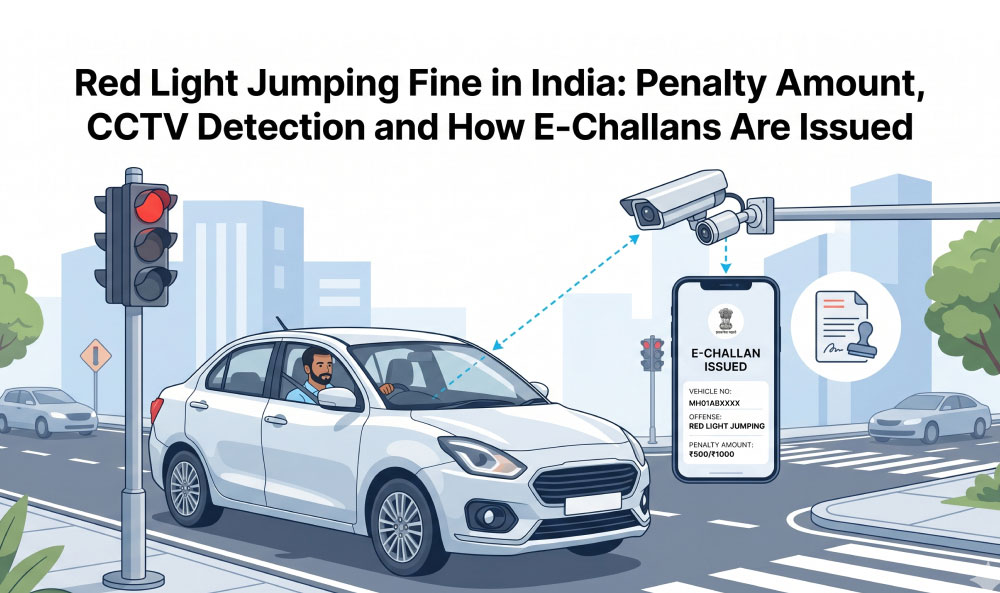
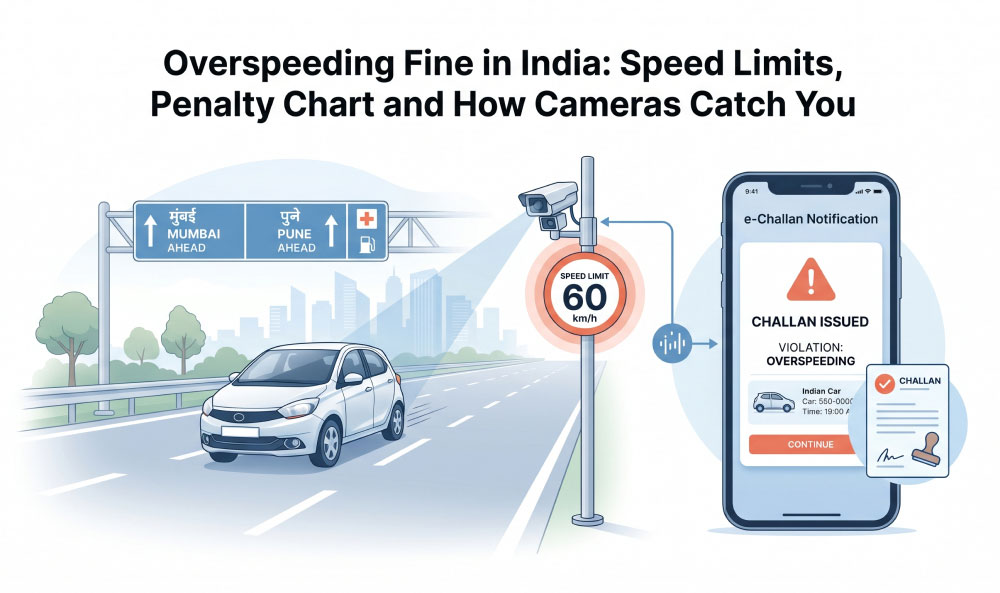
Fixed ANPR cameras are the most common speed enforcement tool on national highways and expressways. These cameras detect vehicle speed using either loop detectors embedded in the road surface or radar sensors mounted alongside the camera. When a vehicle exceeds the posted limit, the camera captures an image, the ANPR system reads the number plate, and an overspeeding challan is created in the Parivahan system automatically. The speed camera fine India generated this way reaches the registered mobile number via SMS within 24 to 72 hours.
How do speed cameras work in India when using the average speed method? This system uses two ANPR points, a set distance apart, to calculate the time a vehicle takes to travel between them. If the average speed implied by that time exceeds the limit, an overspeeding challan is generated. This method is harder to beat than spot-speed cameras because slowing down for one camera does not help if the overall average remains too high.
Radar guns are used by traffic officers during patrols, particularly on state highways and in zones where fixed cameras are not installed. Speed gun detection involves the officer pointing the device at an approaching vehicle, recording the speed reading, and stopping the vehicle for a spot challan if the speed exceeds the limit.
How the Average Speed Enforcement System Works
The average speed enforcement system is being deployed on more highway corridors in India and is worth understanding in detail. In an overspeeding challan generated by average speed cameras, the speed limit in India for cars is calculated across the entire monitored stretch rather than at a single point.
The system works as follows: An entry camera records your number plate and the exact time you pass through. An exit camera does the same. The system divides the distance between the two cameras by the time difference to calculate your average speed. If this average exceeds the posted limit, an overspeeding challan is automatically generated.
This method makes consistent speeding genuinely difficult to avoid on monitored corridors, because the only way to achieve a legal average speed is to drive within the limit throughout the monitored zone.
State-wise Overspeeding Fine Variation
The overspeeding fine India amounts set by the MV Act are national minima. States can apply higher penalties for specific road types or zones. Delhi, for example, enforces strict 30 km/h school zone limits on top of the national overspeeding fine India schedule. Gujarat applies the national schedule with consistent ANPR enforcement on the Ahmedabad-Vadodara Expressway.
For drivers asking about the overspeeding fine on the highway specifically, the amount is consistently Rs 2,000 to Rs 4,000 for light vehicles across all states, since highway enforcement is conducted by the respective expressway authority under the national MV Act schedule.
The Vehicle Info platform allows you to check and pay any outstanding overspeeding challan. Enter your vehicle number, see all pending fines, and pay directly using UPI, card, or net banking. The platform works for challans from any state or highway authority.
FAQs
1. What is the overspeeding fine in India?
Ans: The overspeeding fine India amount is Rs 1,000 to Rs 2,000 for a light motor vehicle on a first offence in a city, and Rs 2,000 to Rs 4,000 on a highway. For medium or heavy vehicles, the speeding penalty is Rs 2,000 to Rs 4,000. Repeat offences attract double the standard rate. The overspeeding penalty by vehicle type means heavier vehicles pay more for the same violation.
2. What is the speed limit in India for cars?
Ans: The speed limit for cars on city roads is 50 km/h. What is speed limit in India for cars on national highways is 100 km/h. School zones and hospital zones have limits as low as 30 km/h. On expressways like the Yamuna Expressway and Bengaluru-Mysuru Expressway, the speed limit is set by the highway authority and is typically 100 km/h for cars with a minimum speed requirement.
3. How do speed cameras work in India?
Ans: How do speed cameras work in India involves two main methods. Fixed ANPR cameras use radar or loop sensors to detect a vehicle's speed at a single point. Average speed cameras use two ANPR points to calculate speed across a corridor. In both cases, the camera reads the number plate and creates an automatic overspeeding challan in the Parivahan system. The speed camera fine India generated is sent via SMS within 24 to 72 hours.
4. What is the overspeeding fine on a highway?
Ans: The overspeeding fine on highway in India is Rs 2,000 to Rs 4,000 for light motor vehicles and Rs 2,000 to Rs 4,000 for heavy vehicles. The speed camera fine India issues for highway violations is typically at the upper range since most ANPR enforcement is on expressways and national highways. Repeat offenders face Rs 4,000 or more. The overspeeding challan is generated automatically and sent to the registered mobile number.
5. Does speed gun detection work differently from cameras?
Ans: Speed gun detection by a traffic officer uses a handheld radar device to measure the speed of an approaching vehicle. If the reading exceeds the speed limit India specifies for that road, the officer stops the vehicle and issues a spot challan using a handheld e-challan device. The overspeeding fine India amount is the same as for camera-generated challans, but the challan is issued in person rather than arriving by SMS.
6. What is the fine for a heavy vehicle exceeding the speed limit?
Ans: The speeding penalty for medium and heavy vehicles in India is Rs 2,000 to Rs 4,000 for a first offence and Rs 4,000 for a repeat. This higher overspeeding penalty by vehicle type reflects the greater stopping distance and collision risk associated with heavier vehicles. The speed limit for car, bike, truck categories differs, with trucks and buses limited to 60 km/h on highways compared to 100 km/h for cars.