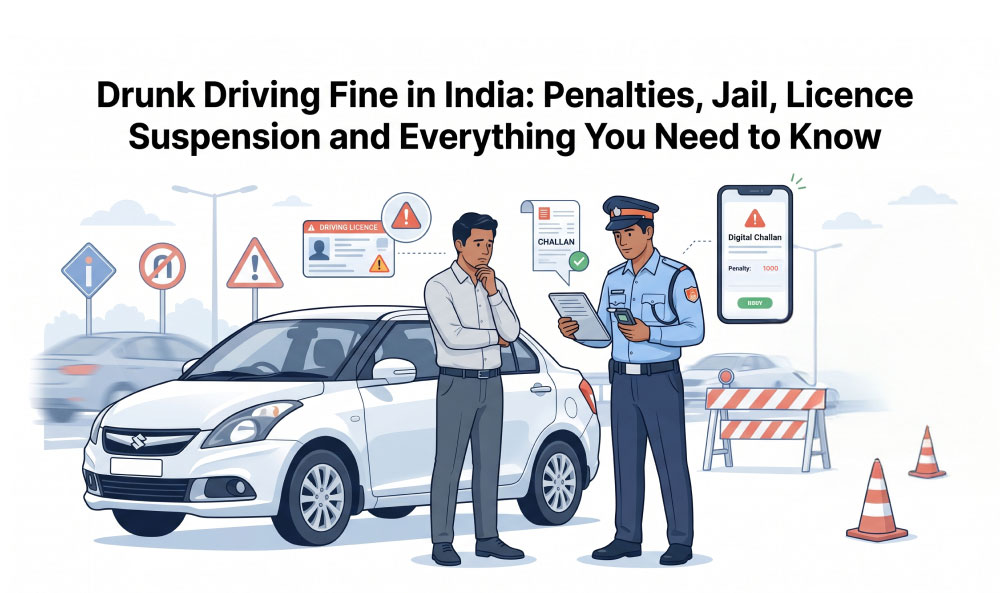
Drunk Driving Fine in India: Penalties, Jail, Licence Suspension and Everything You Need to Know
10 June, 2026
Of all the traffic violations in India, drunk driving carries the most serious consequences. The drunk driving fine India framework under the Motor Vehicles (Amendment) Act, 2019 is not just a financial penalty: it combines a substantial fine with the possibility of imprisonment, licence suspension, and permanent implications for insurance claims. The 2019 amendment made India's drunk driving penalties among the strictest in Asia, and police enforcement has become more systematic with breathalyser tests now conducted routinely at night checkpoints across major cities.
This guide covers the exact drunk driving fine India amounts for first and repeat offences, the blood alcohol limit India law enforces, how licence suspension works, what jail time is possible, how police conduct testing, and what happens to your insurance claim if you were drunk at the time of an accident.
Drunk Driving Laws in India: What the Motor Vehicles Act Says
Drunk driving in India is governed by Section 185 of the Motor Vehicles Act. The law uses the term "driving under the influence of alcohol or drugs" and defines the offence by reference to the blood alcohol concentration (BAC) in the driver's system. The drunk driving penalty MV Act imposes is separate from any criminal law consequences under the IPC, which can apply additionally in cases involving injury or death.
The key principle is that the law does not require proof that your driving was impaired: it requires proof only that your BAC was above the legal limit. Even if you felt entirely in control, exceeding the blood alcohol limit India sets is sufficient to constitute the offence and attract the full drink and drive penalty. The drunk driving fine India of Rs 10,000 for a first offence is what is fine for drunk driving in India most drivers encounter, and it applies automatically upon a confirmed BAC reading above the limit.
BAC Limit India: What Is the Legal Blood Alcohol Limit?
The BAC limit India enforces for private vehicle drivers is 0.03 per cent, which is equivalent to 30 milligrams of alcohol per 100 millilitres of blood. This is stricter than the limit in many European countries (which is typically 0.05 per cent or 0.08 per cent). The BAC limit for driving in India was set at this level in 1994 and has not been revised since, though enforcement has intensified considerably.
For commercial vehicle drivers, including taxi, bus, and truck drivers, the BAC limit India applies at zero: any detectable alcohol in the system constitutes an offence. This zero-tolerance policy for commercial drivers reflects the additional public safety responsibility they carry.
To put the 0.03 per cent limit in context: for most adults, drinking even one standard unit of alcohol can bring the BAC close to or above the legal limit depending on body weight, metabolism, and the time elapsed since consumption. The blood alcohol limit India sets is deliberately low, which means the safe approach for any driver is to consume no alcohol at all before driving.
Drunk Driving Fine: First Offence vs Repeat Offence
The drunk driving fine India amounts are tiered by number of offences:
| Offence | Fine Amount | Imprisonment |
|---|---|---|
| Drunk driving first offence | Rs 10,000 | Up to 6 months |
| Drunk driving repeat offence | Rs 15,000 | Up to 2 years |
The drunk driving first offence fine of Rs 10,000 was a dramatic increase from the pre-2019 amount of Rs 2,000. The 2019 amendment introduced the five-fold increase to create a meaningful deterrent. The drunk driving repeat offence escalates to Rs 15,000 and up to two years of drunk driving jail time, which reflects the legislature's intent to treat repeat drink-driving as a serious criminal matter. Drunk driving jail is not hypothetical: courts regularly impose custodial sentences in aggravated cases.
The DUI fine India applies regardless of whether any accident occurred. Simply being found over the BAC limit at a checkpoint is sufficient to attract the full drink and drive penalty. In cases where drunk driving results in an accident causing injury or death, additional IPC charges apply on top of the MV Act drunk driving fine India.
Licence Suspension for Drunk Driving
The drunk driving licence suspension period is not fixed in the MV Act in the same way as the fine amounts, but licence suspension is a standard consequence of a drunk driving conviction. Courts and licensing authorities typically impose:
- First offence: suspension of driving licence for a minimum of 6 months
- Repeat offence: suspension for a minimum of 2 years, with the possibility of permanent disqualification
The licence suspended drunk driving procedure involves the police confiscating the licence at the time of arrest or after the court conviction. The driver must apply for reinstatement after the suspension period and may be required to pass a fresh driving test in some states before the licence is returned.
A licence suspended drunk driving record also stays on your file. If you apply for a new vehicle or licence renewal, the suspension history is visible to the licensing authority and can affect approvals.
Jail Time for Drunk Driving in India
Can you go to jail for drunk driving in India? The answer is yes. The MV Act explicitly includes imprisonment as a possible consequence. For a drunk driving first offence, up to six months of imprisonment is possible. For a drunk driving repeat offence, up to two years is specified. Courts have discretion on whether to impose a custodial sentence, a fine, or both.
In practice, for first-time offenders who are cooperative and have no prior criminal record, courts often impose the fine and licence suspension without a custodial sentence. However, can you go to jail for drunk driving in cases involving aggravated circumstances such as an accident, injury, or a very high BAC? Yes, and custodial sentences in these cases are significantly more common.
How Police Test for Drunk Driving: Breathalyser and Blood Tests
Traffic police conduct drunk driving checks using a two-stage process. The first stage is a field breathalyser test, administered roadside. If the breathalyser reading is above the legal BAC limit for driving in India, the driver is taken to a medical facility for a confirmatory blood or urine test.
The confirmatory blood test is the legally admissible evidence in court proceedings. The breathalyser result alone is typically used to justify the stop and the blood test request. Refusing to take a breathalyser or blood test is itself an offence under the Motor Vehicles Act and can be treated as an admission of guilt in court proceedings.
Drunk driving checkpoints are most common on Friday and Saturday nights and during festival periods. Major cities including Delhi, Mumbai, Bengaluru, Hyderabad, and Chennai run regular night-time checking operations.
Insurance Claim Rejected If You Were Driving Drunk
One of the most significant consequences of drunk driving that many drivers overlook is the insurance implication. If you are involved in an accident while driving above the BAC limit India sets, your motor insurance policy is void for that accident. The insurer is legally entitled to reject any claim for vehicle damage, third-party liability, or personal injury arising from the accident.
This means that if you damage your own car, damage another vehicle, or injure someone while drunk driving, you bear the full financial cost personally. The drink and drive penalty therefore extends far beyond the Rs 10,000 fine and the possibility of imprisonment: it can result in unlimited civil liability for third-party damages.
To check and pay any outstanding drunk driving challan or e-challan, visit Vehicle Info and enter your vehicle number. All pending challans appear in one view and can be cleared directly on the platform.
FAQs
1. What is the drunk driving fine in India?
Ans: The drunk driving fine India amount is Rs 10,000 for a first offence plus up to six months imprisonment, and Rs 15,000 for a repeat offence plus up to two years. What is fine for drunk driving in India was only Rs 2,000 before the 2019 amendment, making the increase five-fold. Drunk driving jail time is a real possibility for repeat offenders or those involved in accidents, and the fine applies regardless of whether any accident occurred.
2. What is the BAC limit for driving in India?
Ans: The BAC limit for driving in India is 0.03 per cent (30 mg of alcohol per 100 ml of blood) for private vehicle drivers. The blood alcohol limit India enforces for commercial vehicle drivers is zero: any detectable alcohol constitutes an offence. The BAC limit India has been set at 0.03 per cent since 1994. Even a single drink can bring some individuals above this limit depending on body weight and metabolism.
3. Can you go to jail for drunk driving in India?
Ans: Yes, can you go to jail for drunk driving is answered clearly by the Motor Vehicles Act: up to six months for a first offence and up to two years for a repeat. Courts have discretion on whether to impose imprisonment, a fine, or both. For first-time offenders without an accident, courts often impose only the drunk driving fine India and licence suspension. In cases involving injury or a high BAC, custodial sentences are more common.
4. How long is the licence suspension for drunk driving?
Ans: The drunk driving licence suspension period is typically six months for a first offence and up to two years for a repeat offence. Licence suspended drunk driving enforcement involves police confiscating the licence, and reinstatement requires a formal application to the licensing authority after the suspension ends. Repeat offenders may face permanent disqualification in serious cases.
5. Does drunk driving affect my car insurance claim?
Ans: Yes, significantly. If you are involved in an accident while above the BAC limit India sets, your insurer can legally reject the claim for vehicle damage and third-party liability. The drink and drive penalty therefore extends well beyond the Rs 10,000 DUI fine India: it can result in full personal liability for all accident costs. This is one of the most serious unpublicised consequences of drunk driving.
6. Is the drunk driving penalty higher in Gujarat?
Ans: Yes. Gujarat is a prohibition state, meaning alcohol possession and consumption is illegal. The drunk driving penalty MV Act imposes applies alongside criminal charges under the Gujarat Prohibition Act, 1949. The combined consequence in Gujarat, which includes potential vehicle confiscation and extended imprisonment under the Prohibition Act, is significantly more serious than in non-prohibition states.